


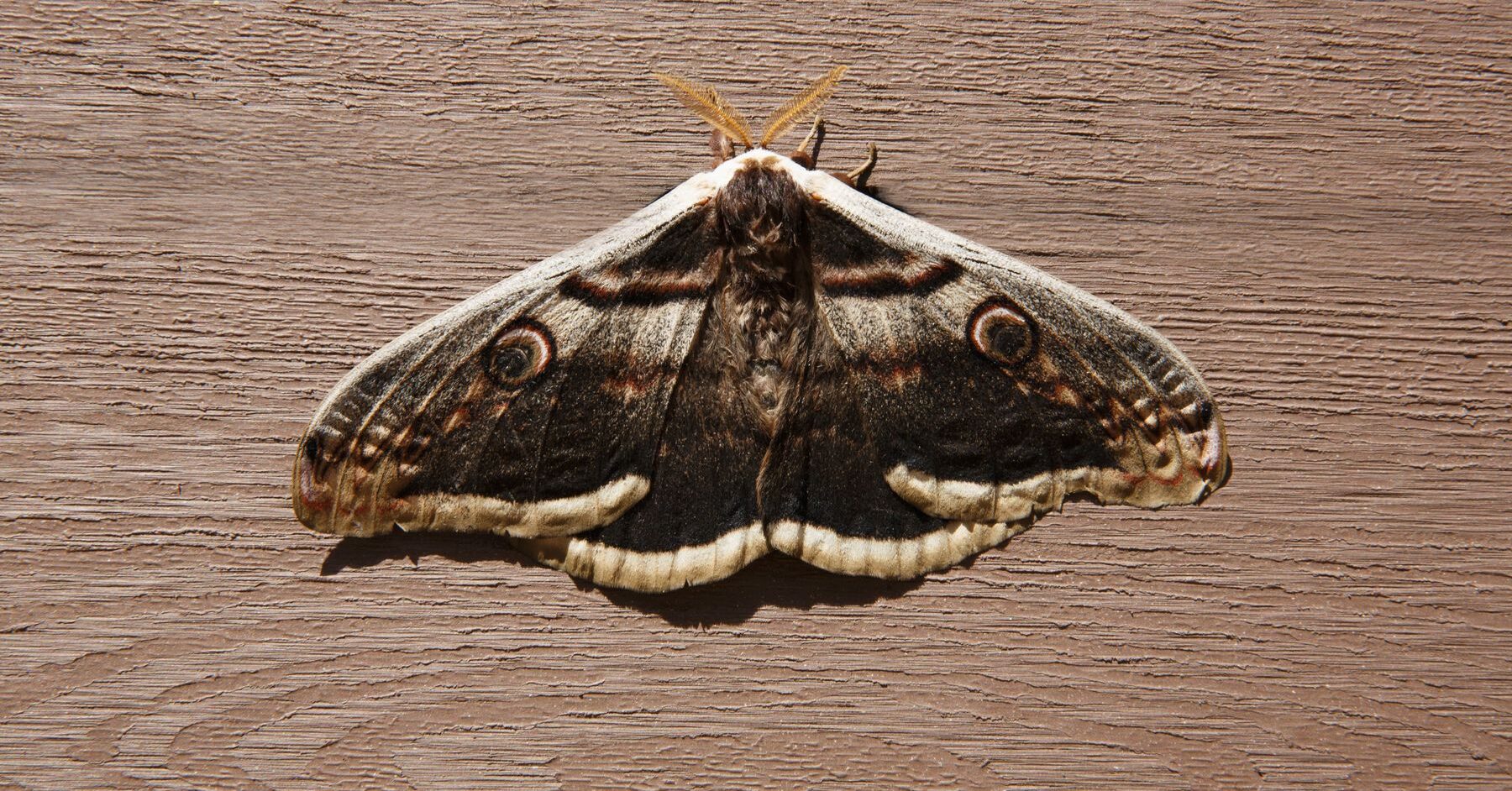
What looks like ordinary powder on a moth’s wings is actually an intricate covering of microscopic structures that can help hide it from the ultrasonic sonar of hunting bats.
The next time a moth lands near a porch light, take a closer look at its wings. Anyone who has handled a moth has probably noticed a fine, powdery substance left behind on their fingers. It looks like dust, yet that familiar powder consists largely of tiny, overlapping scales. In certain moths, researchers have discovered that these scales do something remarkable: they help absorb the ultrasonic sound waves that bats use to hunt.
The scientific discoveries unfolded in stages. Earlier experiments established that moth wing scales could absorb some bat echolocation sound. In November 2018, researchers identified how individual scales resonate at ultrasonic frequencies. A 2020 study then showed that entire scale-covered wings operate as an unusually thin acoustic metamaterial, absorbing a broad band of sound. In 2022, additional experiments explored how well moth wings absorb ultrasound when positioned against a reflective surface.
A Silent Battle in the Night Sky
Many bats hunt by echolocation, emitting high-frequency calls and interpreting the echoes returning from insects, trees, and other objects. A moth flying in darkness cannot simply rely on being invisible. Its wings can reflect the bat’s ultrasonic pulses, revealing its position even when no light is present.
Some moths detect bat calls and take evasive action. Others produce ultrasonic clicks. But some species that lack ultrasound-sensitive hearing have another defense: their wings and bodies absorb part of the incoming sound, making the returning echo weaker. Scientists call this acoustic camouflage. It does not make a moth completely undetectable, but it can reduce the acoustic information available to a hunting bat.
The Extraordinary Engineering of a Single Scale
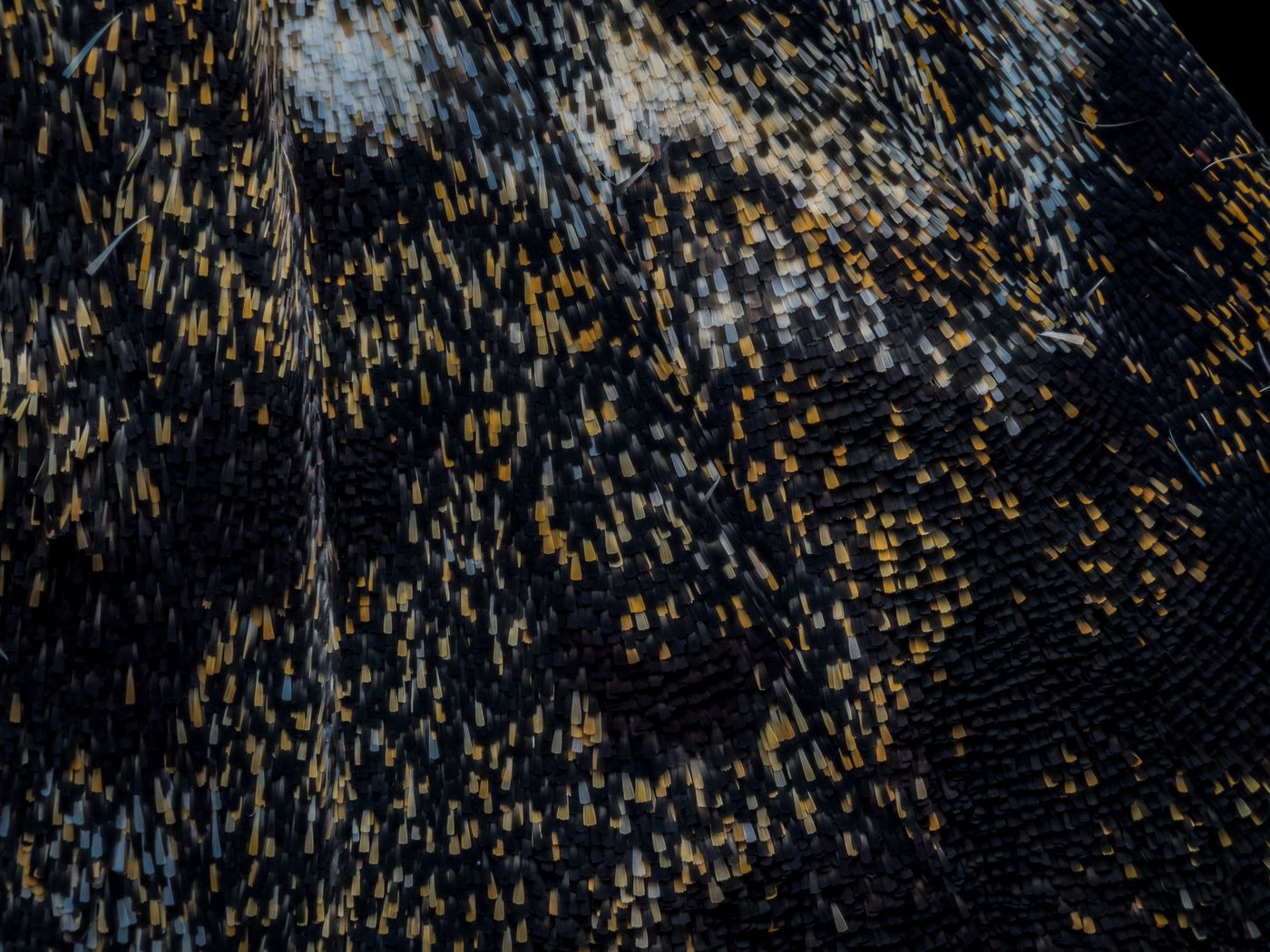
Moth wing scales are not loose dust sprinkled across the surface. They are physical structures attached to the wing, overlapping somewhat like roof shingles. Their principal structural material is chitin, and their forms vary considerably. Under high magnification, scales reveal ridges, cross-connections, internal spaces, and other details that influence their mechanical behavior.
In a 2018 paper in Proceedings of the National Academy of Sciences, researchers investigated the scales of the African cabbage tree emperor moth (Bunaea alcinoe). Using laser Doppler vibrometry, they measured how an individual scale vibrated when subjected to ultrasonic excitation. Three measured resonance modes fell within the range relevant to bat echolocation, with prominent frequencies around 27.6, 90.8, and 152.3 kilohertz.
Resonance occurs when a structure responds especially strongly to particular frequencies. A tuning fork provides a familiar illustration, although a moth scale is far more geometrically complex. Its dimensions, material properties, and internal architecture help determine how it responds. The 2018 work combined real measurements with three-dimensional modeling to investigate that response.
These findings were especially interesting because the scales are so thin and light. A moth cannot simply carry a bulky layer of soundproofing insulation on its wings. Any protective covering must also permit flight.
Thousands of Resonators Working Together
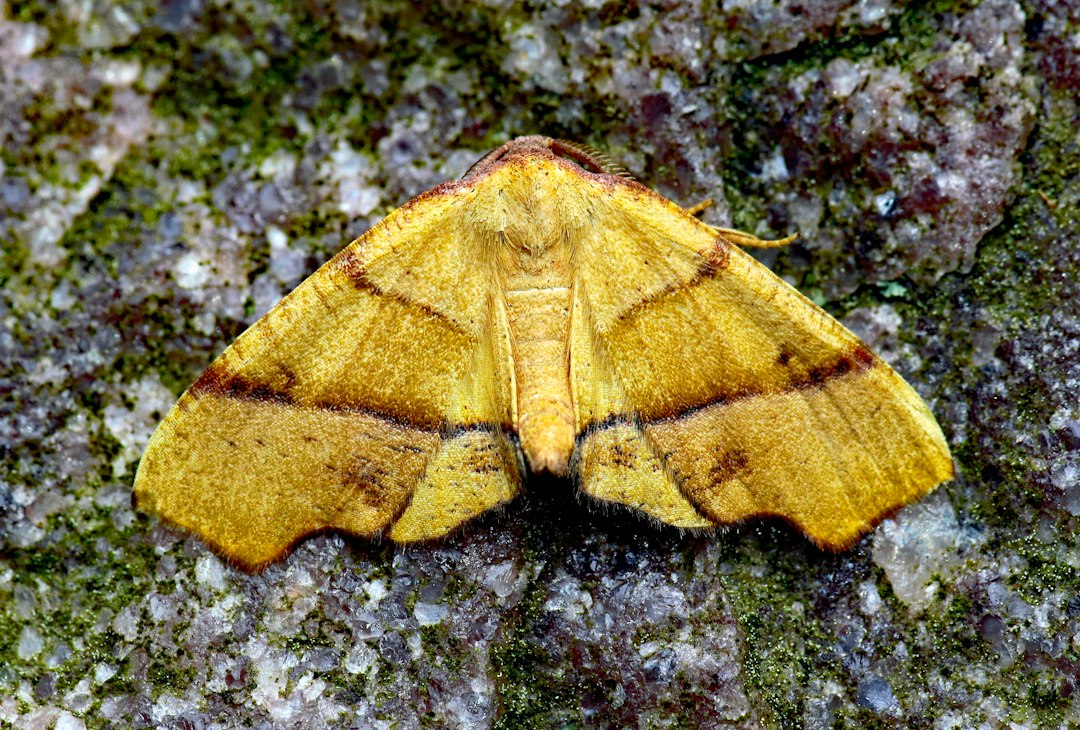
The next major discovery was even more striking. In 2020, researchers studied the wings of Antheraea pernyi and Dactyloceras lucina, moth species lacking ears sensitive to bat ultrasound. Their findings showed that the scales function collectively as a natural acoustic metamaterial: a structured array whose sound-absorbing properties arise from the shapes, resonances, and interactions of many tiny components.
Different scales respond across different portions of the ultrasonic spectrum. Together, they produce broadband absorption over frequencies used by echolocating bats. The researchers measured peak absorption of 72 percent of incident sound intensity at 78 kilohertz. Their wing-scale absorber was also approximately 111 times thinner than the longest sound wavelength absorbed.
It was not just a matter of adding up the performance of individual scales. The researchers reported that the collective absorption exceeded the sum of the scales’ individual contributions. The shared wing membrane and the arrangement of its scale covering helped make the system effective.
Consider the challenge involved. The wings must remain exceptionally thin, flexible, and light, yet their surface interacts with ultrasonic waves whose wavelengths are much larger than the tiny scales. Their special mechanical behavior helps address both requirements at once.
From Moth Wings to Modern Technology
Engineers have become interested in this system because sound-absorbing materials often need considerable thickness. The moth wing provides an intriguing alternative: a lightweight, structured covering of microscopic resonators.
In a 2022 study published in Proceedings of the Royal Society A, researchers placed samples of moth wings against a hard, sound-reflecting surface. In that specific experimental arrangement, the wings reduced reflected ultrasonic sound by as much as 87 percent at 20 kilohertz. That result should not be confused with the 72 percent absorption measured on moth wings in the earlier 2020 study. The researchers were examining different acoustic arrangements.
The work suggests possible paths toward extremely thin sound-absorbing coatings and other lightweight acoustic materials. Such inventions would not require people to use literal moth wings. Instead, engineers hope to reproduce some of the principles found in their microscopic structures. This practice of learning from living organisms to inform technological design is commonly called biomimicry.
A Remarkable Example of Design in Creation
For generations, people brushed what seemed to be ordinary dust from moth wings without realizing that the tiny scales had remarkable acoustic properties. Modern instruments revealed details invisible to the naked eye, and scientific experiments demonstrated just how effectively some of these structures interact with sound.
Within the conventional biological model, researchers interpret these characteristics as adaptations shaped by natural selection in the relationship between moths and bats. Their experiments directly establish the scales’ measurable geometry, resonance, and sound-absorbing capabilities. They do not, by themselves, experimentally reconstruct every historical step by which those structures originated.
From the perspective of biblical creation, the fine-scale architecture and coordinated acoustic performance offer an opportunity to consider the extraordinary functional integration evident in the living world. It is not necessary to exaggerate what the experiments demonstrate. The measured results themselves are remarkable: many tiny, delicately supported structures can cooperate to absorb sound without preventing the moth from flying.
“O LORD, how manifold are thy works! in wisdom hast thou made them all: the earth is full of thy riches.” — Psalm 104:24 (KJV)
The natural world contains remarkable systems that were operating long before anyone possessed the instruments needed to investigate them. In the moth’s wing, something that appears as an insignificant coating of powder turns out to be a sophisticated acoustic defense. What we once overlooked has become a subject of serious scientific investigation and a fresh reason to marvel at the intricacy of creation.

Sources and Further Information
- Shen, Z., et al. (2018). “Biomechanics of a moth scale at ultrasonic frequencies.” PNAS 115(48), 12200–12205.
- Neil, T. R., et al. (2020). “Moth wings are acoustic metamaterials.” PNAS 117(49), 31134–31141.
- Neil, T. R., et al. (2022). “Moth wings as sound absorber metasurface.” Proceedings of the Royal Society A 478, 20220046.
- Shen, Z., et al. (2011). “Moth Wing Scales Slightly Increase the Absorbance of Bat Echolocation Calls.” PLOS ONE 6(11), e27190.