

What the Great Unconformity, Tapeats Sandstone, and Cambrian Fossils Reveal at Grand Canyon
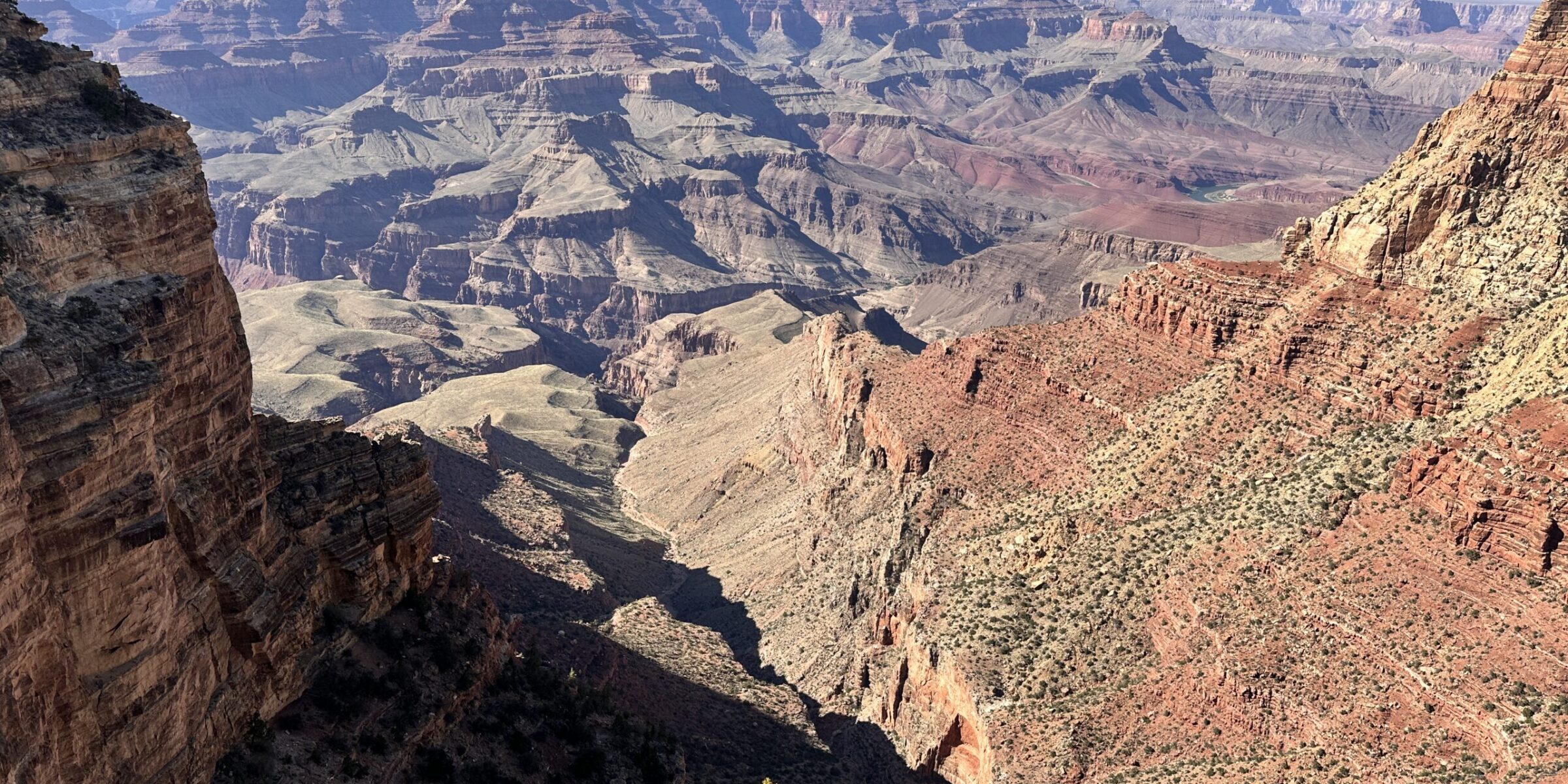
Grand Canyon is one of those places where geology refuses to stay abstract. From the rim, thousands of feet of rock are stacked across the landscape in broad, visible layers. Down inside the canyon, those layers can be walked across, touched, examined, and followed for miles. After more than a thousand days guiding and teaching in Grand Canyon National Park, I still find that one of the most important places to stop is not at the top of the canyon, but near the bottom, at the major erosional boundary commonly called the Great Unconformity.
From a biblical young-earth perspective, that boundary marks a profound transition. Beneath it are rocks belonging to Creation Week and the pre-Flood world: the crystalline basement rocks, including the Vishnu Schist and associated granitic rocks, and in other places the tilted sedimentary and volcanic rocks of the Grand Canyon Supergroup. Above the boundary lies the Tapeats Sandstone, part of the first great sequence of Flood-deposited sedimentary rocks.
Near this same transition, the fossil record also changes dramatically. In the rock units conventionally called Cambrian, abundant complex marine organisms appear in the fossil record. Creation geologists do not accept the conventional evolutionary ages assigned to these units. Terms such as Cambrian, Paleozoic, and Precambrian can still be useful as widely recognized names for rock packages and their relative positions, but in this article they should not be read as endorsements of millions or billions of years. The controlling historical framework is the biblical record of Creation and the global Flood.
The question is not whether Grand Canyon records enormous erosion, moving water, sediment transport, and burial. It clearly does. The question is how those observations fit within the history God has given us in Scripture.
The Great Unconformity in a biblical framework
An unconformity is a surface where rock has been eroded away or where deposition was interrupted before another rock unit was placed above it. At Grand Canyon, the Tapeats Sandstone rests directly on the crystalline basement rocks in some locations and across the truncated, tilted layers of the Grand Canyon Supergroup in others. Where the Tapeats rests on the crystalline basement, the contact is commonly called the Great Unconformity. Where it truncates the angled Supergroup layers, geologists may more specifically call it the Great Angular Unconformity. Creationist literature often discusses both as parts of the same major regional erosional transition.
Canyon Ministries describes the Great Unconformity as the boundary between Creation Week or pre-Flood rocks below and Flood-deposited strata above. At Blacktail Canyon, for example, the Tapeats rests directly on crystalline basement rock. Elsewhere, the Flood waters cut across the Grand Canyon Supergroup before the Tapeats was deposited.
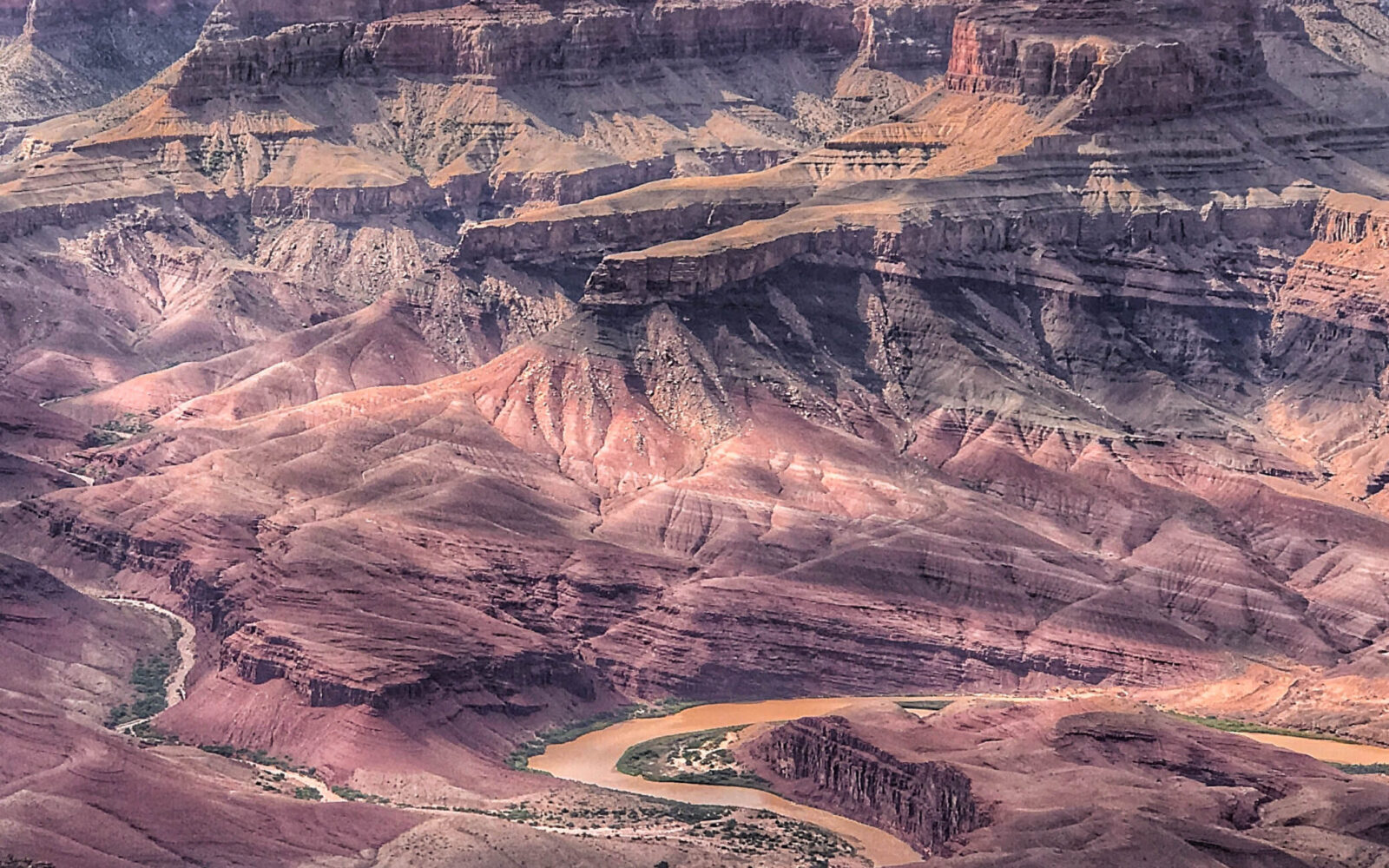
The sequence is visually straightforward. The rocks beneath the boundary were already present before the Tapeats. The Grand Canyon Supergroup had been tilted. Then a massive erosional event planed across those rocks, removing an extraordinary volume of material. After that erosion, the Tapeats Sandstone was deposited across the resulting surface.
Within the biblical model, this does not represent an immense interval of missing time. It represents a major erosional surface formed at or near the beginning of Noah’s Flood. The pre-Flood surface was scoured by powerful water as the Flood advanced across the continents, and the first widespread Flood sediments were then laid down across that surface.
That interpretation has been central to creationist Grand Canyon geology for decades. Dr. Steven Austin’s landmark volume Grand Canyon: Monument to Catastrophe developed the canyon within a young-earth, global-Flood framework, and subsequent work by creation geologists has continued to examine the Great Unconformity as evidence of large-scale catastrophic erosion. Dr. Andrew Snelling has likewise emphasized the enormous lateral extent of the erosional surface and the strata deposited above it.
This is why the Great Unconformity is so important. It is not simply an unusual contact between two rock units. It is an erosional boundary of enormous scale, followed immediately by equally impressive sediment deposition.
The Tapeats Sandstone: the first great Flood deposit
The Tapeats Sandstone forms one of the most recognizable units in the inner canyon, commonly producing a resistant cliff above the basement rocks. Within the biblical Flood framework, it represents the first major Flood-deposited layer in the Grand Canyon sequence. The Tapeats and related basal sandstones extend across enormous areas of North America, and equivalent sandstone packages occur on other continents.
Canyon Ministries has long emphasized the broad geographic extent of the Tapeats, while creation geologists such as Austin and Snelling have pointed to its sedimentary structures, basal conglomerates, and regional continuity as evidence of powerful water moving sediment across a continental scale.
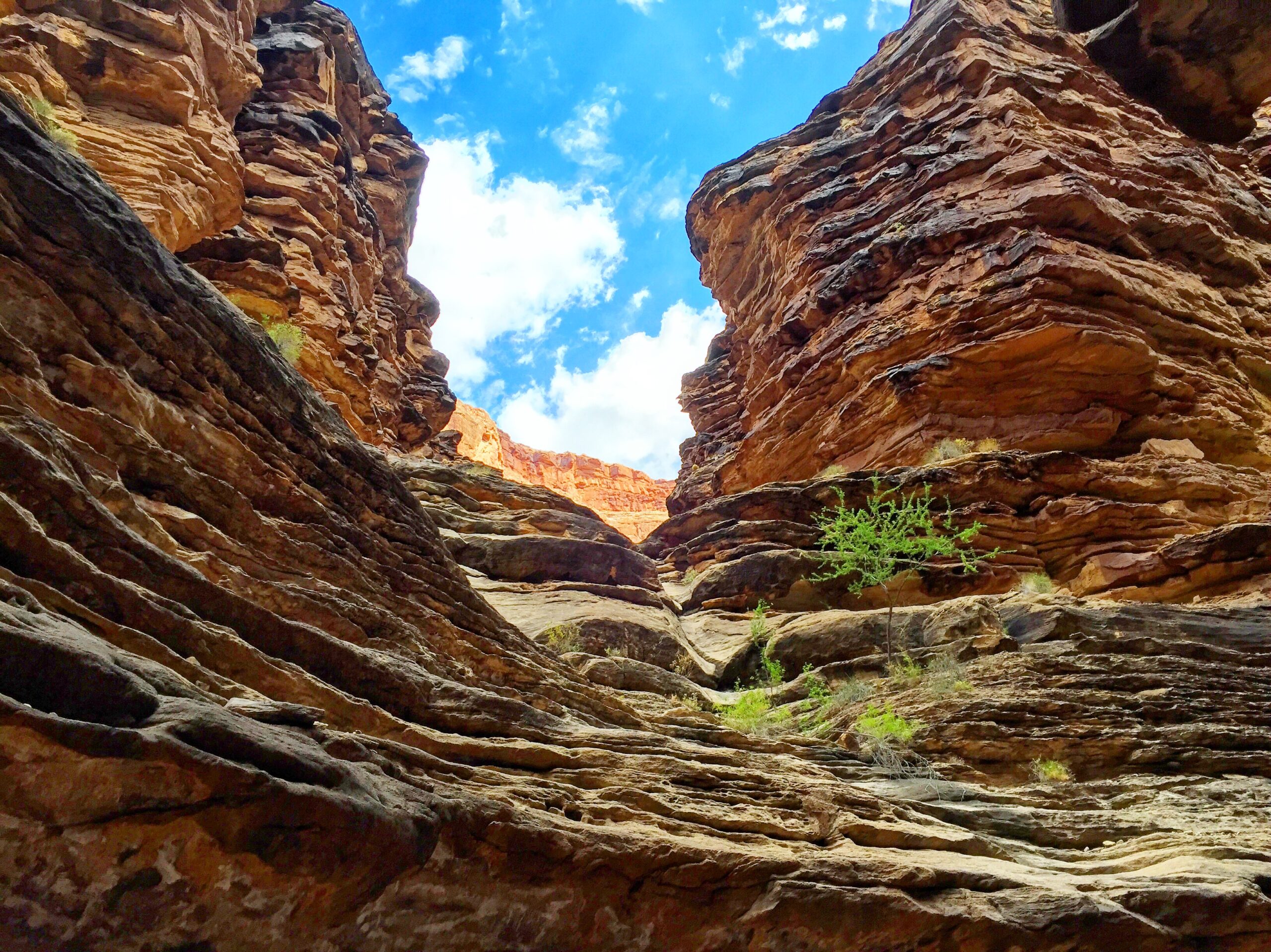
The Great Unconformity and the Tapeats belong together in that story. The boundary records removal. The sandstone above records transport and deposition. In the Flood model, these are not isolated geological puzzles. They are successive parts of the same catastrophic process: widespread erosion of the pre-Flood surface followed by the rapid deposition of sediment as Flood waters advanced.
Genesis does not describe the Flood as merely forty days of rain falling on an otherwise quiet world. Genesis 7:11 says that the “fountains of the great deep” were broken up and the windows of heaven were opened. The Hebrew tehom, translated “deep,” refers to the great body of deep waters. The language describes a catastrophe involving waters from below as well as above.
The scope of that inundation is made explicit later in the chapter. Genesis 7:19–20 describes the waters prevailing until all the high mountains under the whole heaven were covered. The geological model being considered here therefore begins with the text itself: a catastrophic event initiated by the breaking up of the great deep and progressing to global inundation.
Creation geologists therefore place the opening stages of the Flood within a period of intense tectonic disruption, erosion, sediment transport, and marine inundation. The Great Unconformity and the overlying Tapeats Sandstone fit naturally into that sequence. The rocks beneath belong to the created and pre-Flood world. The Tapeats marks the beginning of a new geological regime dominated by the Flood.
The Tapeats is not an isolated sandstone body. It forms the basal unit of the Tonto Group, followed upward by the Bright Angel Formation and the Muav Limestone. Together these formations record a major episode of marine inundation and sedimentation across the region during the early stages of the Flood. That same broad interval is also where the fossil record becomes dramatically richer in abundant, complex marine life. In other words, the geological transition includes not only erosion and deposition, but also the large-scale burial of marine ecosystems.
Where the fossil record suddenly changes
The same part of the rock record brings another striking change. Creationists sometimes summarize the transition by saying that the great fossil record begins near the base of the Flood sequence. That needs a little precision. Rocks assigned to the conventional Precambrian contain stromatolites, microbial fossils, and some other fossil forms. The point is not that absolutely nothing is found below the Cambrian. The point is that the fossil record changes dramatically as abundant, complex marine animals appear in the Cambrian strata.
The term Cambrian Explosion itself reflects that abruptness. Many major animal body plans appear conspicuously in these rocks, along with abundant trilobites, brachiopods, sponges, burrows, trackways, and other evidence of complex marine ecosystems. The conventional evolutionary framework stretches this transition across millions of years. The creationist framework does not. Instead, it asks what would happen when the earliest stages of a global marine catastrophe began destroying and burying whole ecological communities.
At Grand Canyon, the Bright Angel Formation provides a particularly useful example. It contains abundant marine fossils and trace fossils, including trilobites and their trackways, along with evidence of burrowing organisms living in shallow marine environments. These fossils occur within the same lower Tonto sequence that overlies the Great Unconformity and follows the widespread deposition of the Tapeats. The convergence is difficult to miss: large-scale erosion below, widespread water-laid sediment above, and abundant burial of complex marine organisms within the same broad geological transition.
Answers in Genesis geologists describe the fossil order as a burial sequence produced during the Flood. Marine bottom-dwelling organisms and shallow-sea communities would be among the first ecosystems catastrophically buried as the fountains of the great deep broke open and powerful waters surged across ocean floors and continental margins. As the Flood progressed, additional environments at progressively higher positions would be overwhelmed.
That is a very different way of reading the fossil record. Rather than assuming that vertical order primarily represents evolutionary succession through deep time, Flood geology looks first at ecology, elevation, mobility, hydrodynamic sorting, transport, and progressive inundation. Organisms that lived in different environments should not be expected to appear randomly mixed in every layer.
Why the first Flood fossils are marine
This also helps answer a common question: if Noah’s Flood destroyed human beings and terrestrial animals, why are human fossils not found in the Tapeats Sandstone or other low Grand Canyon layers?
Within the creationist model, those lower Flood strata largely record marine environments affected during the opening phases of the catastrophe. If ocean-floor and continental-margin ecosystems were being destroyed first, then marine organisms are exactly what we would expect to find buried there. Human populations and most terrestrial animals occupied very different environments and would have entered the burial record later, if they were preserved at all.
A global Flood does not require every organism to be jumbled together indiscriminately. Habitat, water depth, elevation, mobility, current direction, sediment density, body shape, and the timing of inundation all influence burial. Dr. Austin and other Flood geologists have repeatedly emphasized that an ordered fossil record is not inconsistent with catastrophe. A catastrophe acting across diverse ecological zones should itself produce order.
The Grand Canyon sequence is therefore best understood within the larger Flood record. The canyon exposes an extraordinary cross section, but it does not expose every environment buried during the Flood or every layer that once existed above the present rim.
The canyon walls preserve only part of the Flood sequence
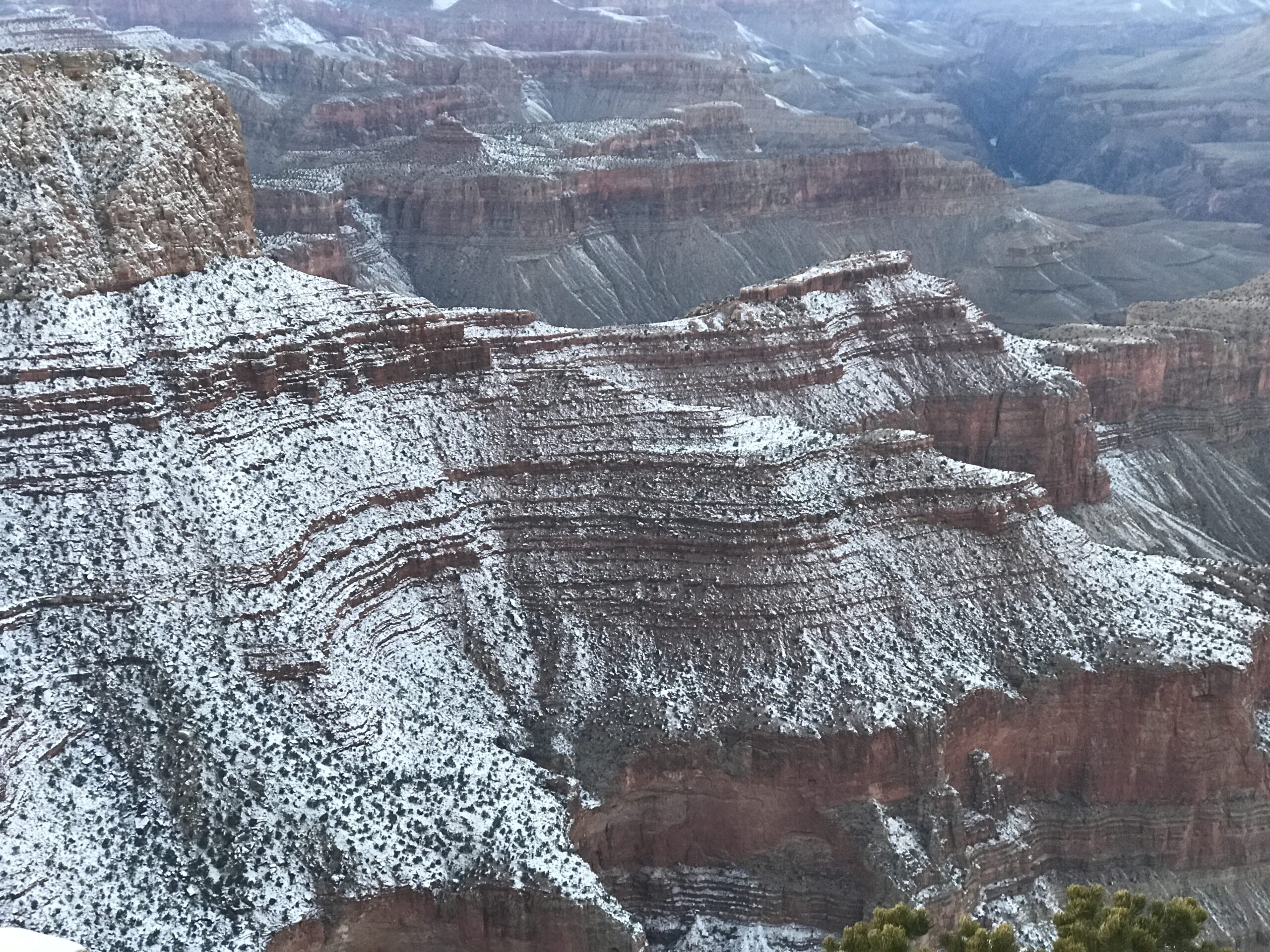
The Kaibab Limestone at the South Rim is not the final layer of the regional Flood record. Additional strata are preserved farther north through the Grand Staircase in northern Arizona and southern Utah. Within the biblical model, much of that material was once more extensive across the region and large volumes were stripped away as Flood waters receded.
One current creationist model for Grand Canyon formation distinguishes between deposition of the major Grand Canyon sedimentary sequence during the Flood and the later excavation of the modern canyon. The Tapeats through the Kaibab represent successive phases of Flood deposition. Later, receding Flood waters produced enormous sheet erosion and denudation across the Colorado Plateau, removing much of the overlying Grand Staircase material.
The canyon itself appears to be a later erosional feature cut into that already established framework. Creation researchers have proposed several models for its excavation, including catastrophic drainage associated with large post-Flood lakes, regional uplift, and rapid erosion. Those questions remain an active area of creationist research, and we do not need to force every stage of Grand Canyon history into a single moment of the Flood.
What matters here is the sequence. Creation and pre-Flood rocks lie below. The Great Unconformity records catastrophic erosion at the onset of the Flood. The Tapeats and the great horizontal sedimentary formations above record Flood deposition. Later erosion removed enormous volumes of sediment and eventually carved the canyon through those already existing layers.
Reading the rocks within biblical history
Creationists and conventional geologists often use the same names for formations and rock systems. We both speak of the Tapeats Sandstone, Bright Angel Formation, Muav Limestone, Redwall Limestone, and Kaibab Limestone. Terms such as Cambrian, Paleozoic, and Precambrian can also be useful because they identify recognized packages of rock and their relative positions within the standard stratigraphic column.
But shared nomenclature does not require a shared chronology. When I refer to the crystalline basement rocks as lying beneath the Tapeats, I am describing their physical and stratigraphic position, not assigning them an evolutionary age of more than a billion years. Within the biblical framework used here, the basement rocks originated during Creation Week, particularly in connection with the formation of the dry land, while the Grand Canyon Supergroup belongs within Creation Week and subsequent pre-Flood history. The Tapeats and the major horizontal strata above it were then deposited during Noah’s year-long Flood.
Likewise, when conventional ages are mentioned, they should be recognized as interpretations assigned within an old-earth model, not as measured properties of the rocks themselves. Rock names, contacts, structures, fossils, grain sizes, and sedimentary relationships are observations. The vast ages attached to them are part of a historical interpretation.
The goal is therefore not to deny the physical geology in front of us, but to interpret those observations within the history given in Scripture. Creation geologists such as Dr. Steven Austin and Dr. Andrew Snelling have contributed important field research and detailed geological arguments within that framework, but the evidence itself must ultimately carry the case.
We can observe the erosional surface beneath the Tapeats. We can observe the tilted Supergroup rocks truncated below it. We can observe coarse sediment and cross-bedding in the Tapeats. We can trace vast sedimentary units over great distances. We can examine marine fossils and trace fossils in the early Flood strata. The question is how those observations fit into earth history.
Within the biblical framework, they fit into a several-thousand-year history: Creation Week, the pre-Flood world, the global Flood, and subsequent post-Flood events. That framework does not give creation geologists permission to ignore difficult evidence. It gives us a history to test against the evidence. Grand Canyon is valuable precisely because so much of that evidence is exposed on an enormous scale.
Judgment recorded in stone
The Flood is also more than a geological event. Genesis presents it as divine judgment on a world filled with violence and wickedness. The fossils preserved throughout Flood-deposited rocks represent creatures that lived and died. The strata are beautiful today, but within a biblical framework they also preserve a record of catastrophe.
That gives Grand Canyon a sobering depth that goes beyond scenery. We stand at the rim and admire cliffs glowing in evening light, deep side canyons disappearing into shadow, and the Colorado River winding far below. Yet many of the rocks producing that beauty were laid down during an event of judgment.
And still, the story does not end with judgment. Scripture repeatedly shows God bringing restoration out of destruction: the Flood followed by covenant, exile followed by return, death followed by resurrection. Grand Canyon has become one of the most magnificent landscapes on earth, a place where millions of people stop in wonder at what they see.
That is why I do not want people simply to leave Grand Canyon saying, “That was beautiful.” I want them to ask deeper questions. What happened here? What kind of event could erode a continental-scale surface, move enormous quantities of sediment, bury entire marine communities, and leave layer after layer spread across the continent? And most importantly, how does the history revealed in Scripture help us understand what we are seeing?
The Great Unconformity, the Tapeats Sandstone, and the sudden abundance of Cambrian marine fossils fit naturally within the opening stages of the global Flood. Beneath the boundary is the created and pre-Flood world. At the boundary is catastrophic erosion. Above it begins the great record of Flood deposition and burial.
Grand Canyon is therefore not a monument to deep time. From a biblical perspective, it is a monument to Creation, catastrophe, judgment, preservation, and ultimately the God whose Word provides the history needed to understand His world.

Sources and further reading
- Canyon Ministries — The Great Unconformity in the Grand Canyon
- Canyon Ministries — What Makes the Grand Canyon Grand? Geology & the Flood
- Canyon Ministries — How Was the Grand Canyon Formed? A Catastrophic Lake Spillover Model
- Steven A. Austin, ed., Grand Canyon: Monument to Catastrophe (Institute for Creation Research, 1994).
- Andrew A. Snelling — Grand Canyon Evidences that Confirm the Bible, Answers in Genesis
- Andrew A. Snelling — Tonto Depositional Processes and Rates, Answers in Genesis
- Institute for Creation Research — Young-Earth Creationist Bibliography, including Austin’s Grand Canyon: Monument to Catastrophe
- Nate Loper — Grand Canyon and the Biblical Flood presentation