

From Jerusalem to Rome, the First Christians Left Footprints We Can Still Trace
The history of the early church is sometimes told almost entirely through names, dates, councils, and theological debates. Yet the first generations of Christians did not live in an abstract world. They walked paved Roman roads, passed through crowded marketplaces, gathered in cities filled with temples and civic monuments, appeared before government officials, and carried the message of Jesus across a Mediterranean world whose physical remains can still be seen today.
Few lives connect that landscape to the New Testament as clearly as the apostle Paul. The book of Acts follows him through Cyprus, Asia Minor, Macedonia, Greece, Judea, and eventually Rome. His letters were written to churches in places such as Corinth, Philippi, Thessalonica, Ephesus, and Rome. Archaeology cannot prove every theological claim Paul made, nor is that what archaeology is designed to do. What it can do remarkably well is illuminate the world in which those claims were preached, written, opposed, and preserved.
Taken together, these archaeological discoveries do more than confirm scattered details. They help reconstruct the setting in which the first-century church moved from Jerusalem into the heart of the Roman world.
The earliest chapters of church history unfolded on real roads, in real cities, before real officials, among communities whose names would continue to appear in Christian writings long after the book of Acts ends.
A church born in Jerusalem, but not confined to it
The Christian movement began in Jerusalem, and its earliest members were overwhelmingly Jewish. That matters for understanding the first major questions the church faced. The issue was not simply how to spread a new religion. The deeper question was how the promises of Israel’s Messiah related to Gentiles who were now believing in Christ.
One of the most vivid archaeological reminders of that tension is the surviving Temple warning inscription from Jerusalem. Ancient sources describe a barrier within the Temple complex beyond which Gentiles were not permitted to pass. An inscription discovered in the nineteenth century warned foreigners not to enter the restricted area and placed responsibility for the penalty of death on anyone who violated the boundary.
That physical barrier gives important context to Acts 21, where Paul was seized after some Jews mistakenly concluded that he had brought Trophimus, an Ephesian Gentile, into a prohibited part of the Temple. The resulting uproar nearly cost Paul his life.
It also provides a striking backdrop to Paul’s language in Ephesians about Christ breaking down the “dividing wall of hostility” between Jew and Gentile. Whether Paul was referring directly to the Temple barrier or drawing more broadly on the social and religious separation it represented, his readers lived in a world where such boundaries were anything but theoretical.
The question of Gentile inclusion had already come to a head at the Jerusalem Council in Acts 15. By the time Paul began his major missionary journeys, the church had made a decisive turn outward. The movement that began in Jerusalem was becoming a trans-Mediterranean church.
Roman roads and the spread of the gospel
That expansion was aided by one of Rome’s greatest achievements: its transportation network. The Romans did not build their roads to help Christian missionaries. They built them for imperial administration, military movement, trade, and communication. Yet those same roads gave Paul and other travelers a remarkably effective way to move from city to city.
Sections of roads associated with Paul’s travels remain visible today. The Via Sebaste crossed portions of Asia Minor. The Via Egnatia linked important Macedonian cities and connected the Adriatic with the eastern regions of the empire. The Appian Way carried travelers toward Rome. These were not obscure back trails. They were part of the arteries of Roman power.
Paul’s missionary pattern makes sense against that infrastructure. He repeatedly entered significant urban centers, preached there, gathered believers, and then moved onward while maintaining contact through messengers and letters. Roads, routes, and Roman cities became conduits through which the Christian message traveled with surprising speed.
By the end of Acts, the geographic arc is unmistakable: Jerusalem, Antioch, Asia Minor, Macedonia, Greece, and finally Rome. The gospel was moving along many of the same pathways that moved soldiers, merchants, officials, and imperial correspondence.
Cyprus and a Roman official who listened
Paul’s first missionary journey brought him to Cyprus, where Acts identifies Sergius Paulus as the Roman proconsul. The account places the Christian mission in direct contact with the governing structure of a Roman province. According to Acts 13, Sergius Paulus summoned Barnabas and Paul because he wanted to hear the word of God.
Several inscriptions have been associated with the wider Sergii Pauli family, and one Roman inscription from the mid-first century mentions a Lucius Sergius Paulus in a setting consistent with the kind of political career that could have included provincial service. None of these inscriptions by itself allows us to say with certainty, “This is unquestionably the man in Acts.” They do, however, place people bearing the relevant name and status squarely within the first-century Roman administrative world Luke describes.
The episode is important for early church history because it marks more than a personal conversion. Acts is showing the Christian message moving beyond synagogue communities and into direct contact with Gentile political authority. The church was no longer a Jerusalem phenomenon, or even merely a Jewish diaspora movement. It was becoming visible within Roman provincial society.
Philippi and Thessalonica: churches along the Roman highways
Paul’s entrance into Macedonia brought the gospel into cities that would become some of the best-known communities in early Christianity. Philippi and Thessalonica sat within a well-connected Roman world, and Luke’s descriptions repeatedly show close familiarity with local political structures.
At Thessalonica, Acts refers to city officials as politarchs. The title was once so uncommon in surviving literary sources that some critics regarded Luke’s terminology with suspicion. Archaeological inscriptions from Thessalonica and elsewhere in Macedonia have since demonstrated that politarch was indeed a local civic title used in the region.
This is exactly the kind of detail archaeology is especially good at testing. Luke did not simply call every official a governor or magistrate. He used terminology that varied from place to place. Similar evidence exists for the Asiarchs mentioned at Ephesus. Such titles root Acts in the complicated civic vocabulary of the Roman provinces.
More importantly, Paul did not simply pass through these cities and disappear. Churches remained behind. His letters to the Philippians and Thessalonians show communities learning to live as Christians after the missionary had moved on. Church history, in that sense, begins before Acts is finished. The story is already shifting from apostles planting congregations to congregations developing their own endurance, leadership, worship, and witness.
Athens and the intellectual world of the Greeks
When Paul reached Athens, he entered a city whose political glory had faded from its classical peak but whose intellectual and religious prestige remained enormous. Acts describes him reasoning in the synagogue and marketplace before being brought to the Areopagus.
The word Areopagus could refer to the famous rocky outcrop northwest of the Acropolis as well as to the council associated with it. The exact setting of Paul’s address continues to be discussed, but the larger context is clear. Here Christianity was confronting a sophisticated pagan culture on its own ground.
Paul’s address in Acts 17 is therefore an important moment in the history of Christian apologetics. He begins with observations drawn from Athenian religion, speaks of the Creator as Lord of heaven and earth, affirms the unity of humanity, calls his hearers to repentance, and ends with the resurrection.
This was not an attempt to disguise Christianity as Greek philosophy. It was an example of communicating biblical truth in a setting whose assumptions were very different from those of a synagogue audience. That challenge would only grow as Christianity spread through the Greco-Roman world.
Corinth: archaeology, chronology, and a growing church
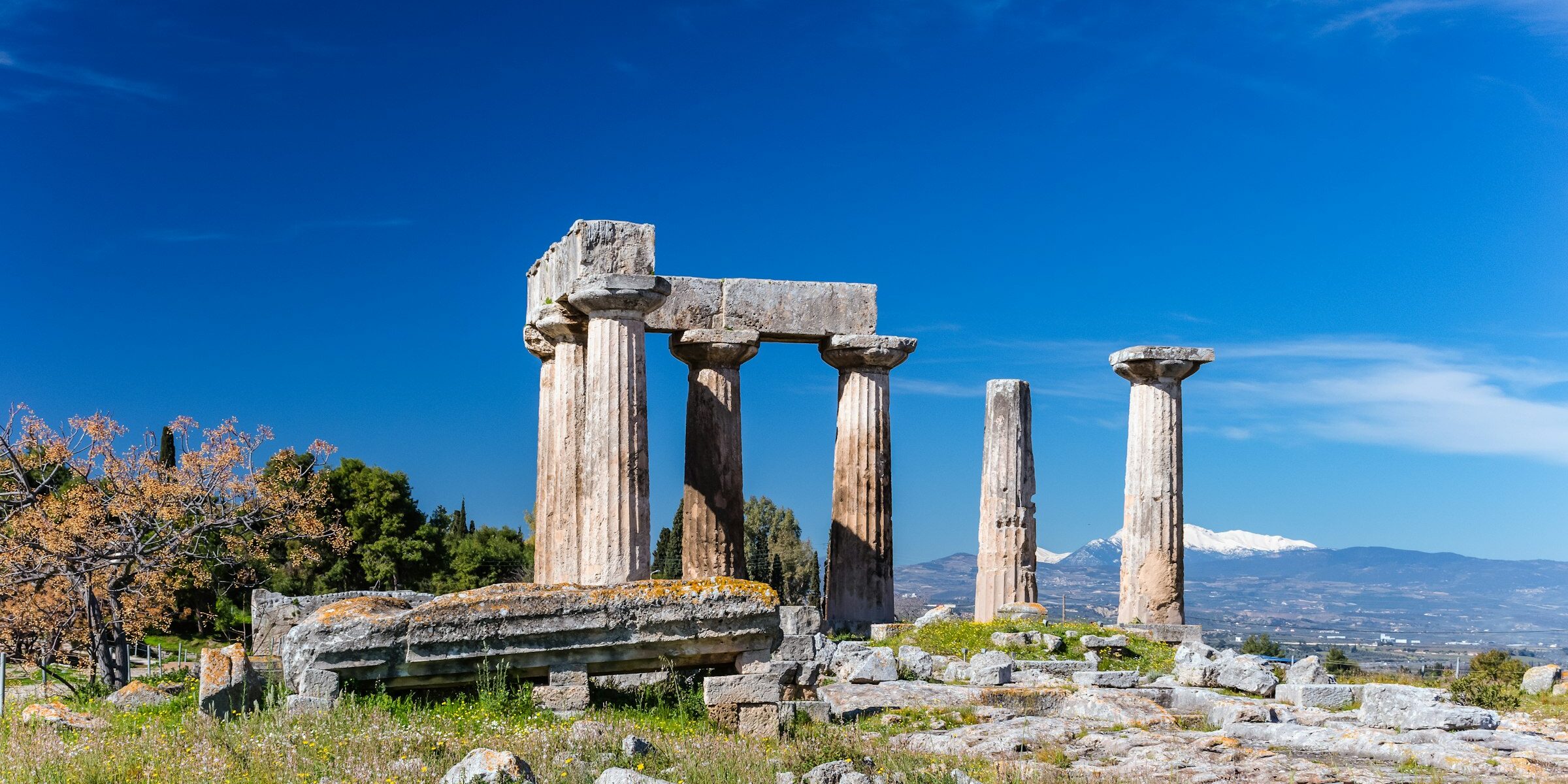
Few New Testament cities offer as many useful intersections between text and archaeology as Corinth. Paul spent an extended period there, founded a church there, wrote letters to it, and later wrote Romans while staying in the city.
One of the best-known finds is the Erastus inscription, discovered near the theater area. It records that an Erastus paid for pavement at his own expense in connection with holding civic office. Romans 16:23 mentions an Erastus associated with the city treasury or administration. Because the name was not unique and the precise relationship between the terms used for the offices is debated, the inscription should not be presented as certain identification. It is, however, an intriguing possible connection between Paul’s circle and Corinth’s civic life.
Another structure can be identified much more securely: the bema, or judgment platform, in the Corinthian forum. Acts says that opponents brought Paul before Gallio, the proconsul of Achaia, and accused him of persuading people to worship God contrary to the law. Gallio dismissed the case.
The surviving bema gives physical shape to Acts 18. We can stand in the same civic center where Roman officials publicly heard cases and issued decisions. Even if every architectural element visible today does not date precisely to Paul’s appearance, the location places the event within an identifiable municipal landscape rather than a generalized ancient setting.
The most important chronological evidence comes from Delphi rather than Corinth. The Gallio inscription preserves a letter of the emperor Claudius that names Lucius Junius Gallio as proconsul of Achaia. Because the inscription can be dated closely, it provides one of the strongest external anchors for reconstructing Pauline chronology. Scholars commonly place Gallio’s proconsulship around AD 51–52, which in turn helps date Paul’s stay in Corinth and events before and after it.
This matters enormously for early church history. Once one secure point is established, Paul’s journeys and letters can be arranged around it with greater confidence. Archaeology is not merely supplying interesting background. It is helping place the emerging church onto the timeline of the Roman Empire.
Ephesus: when the Christian movement became publicly disruptive
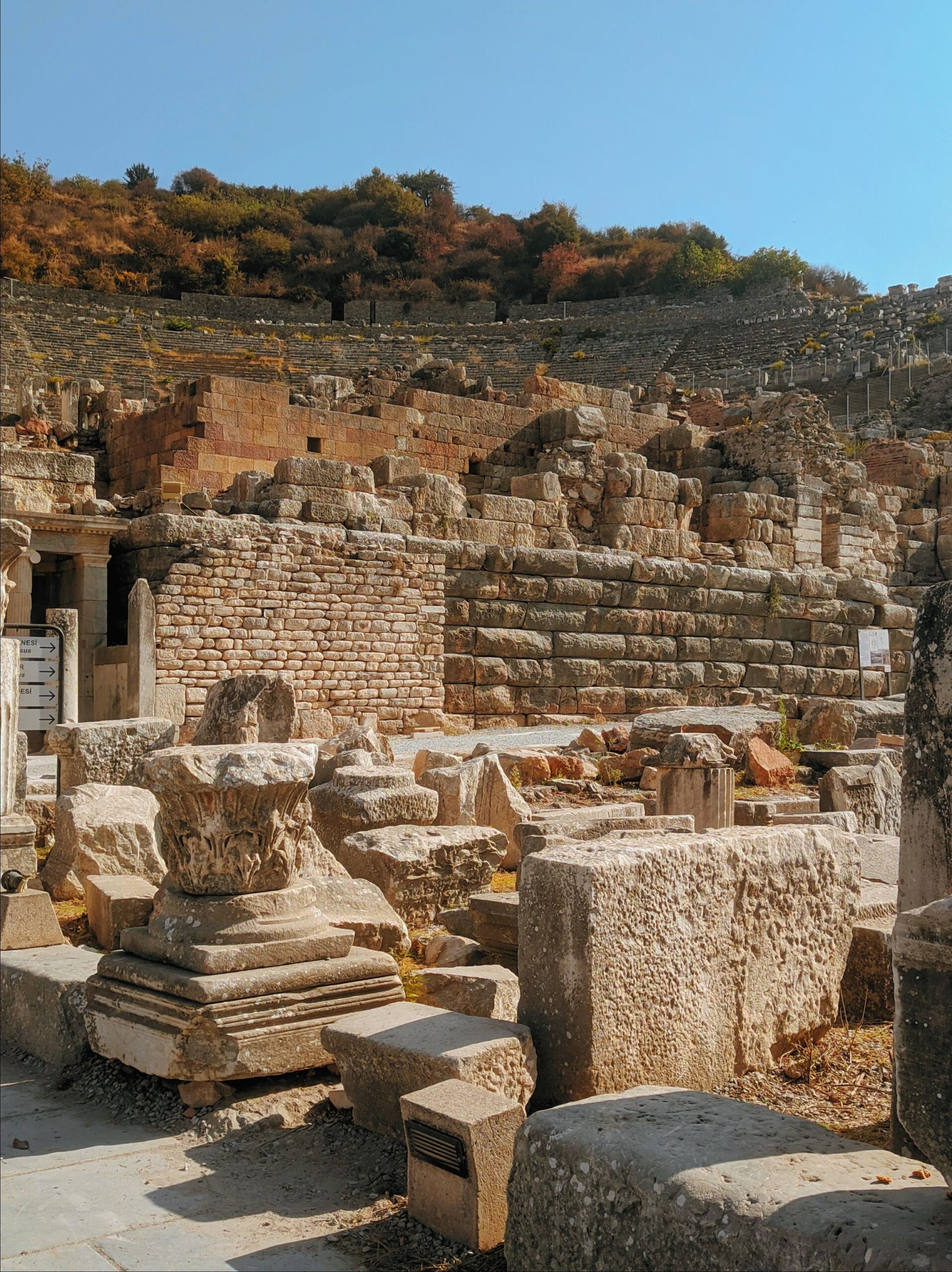
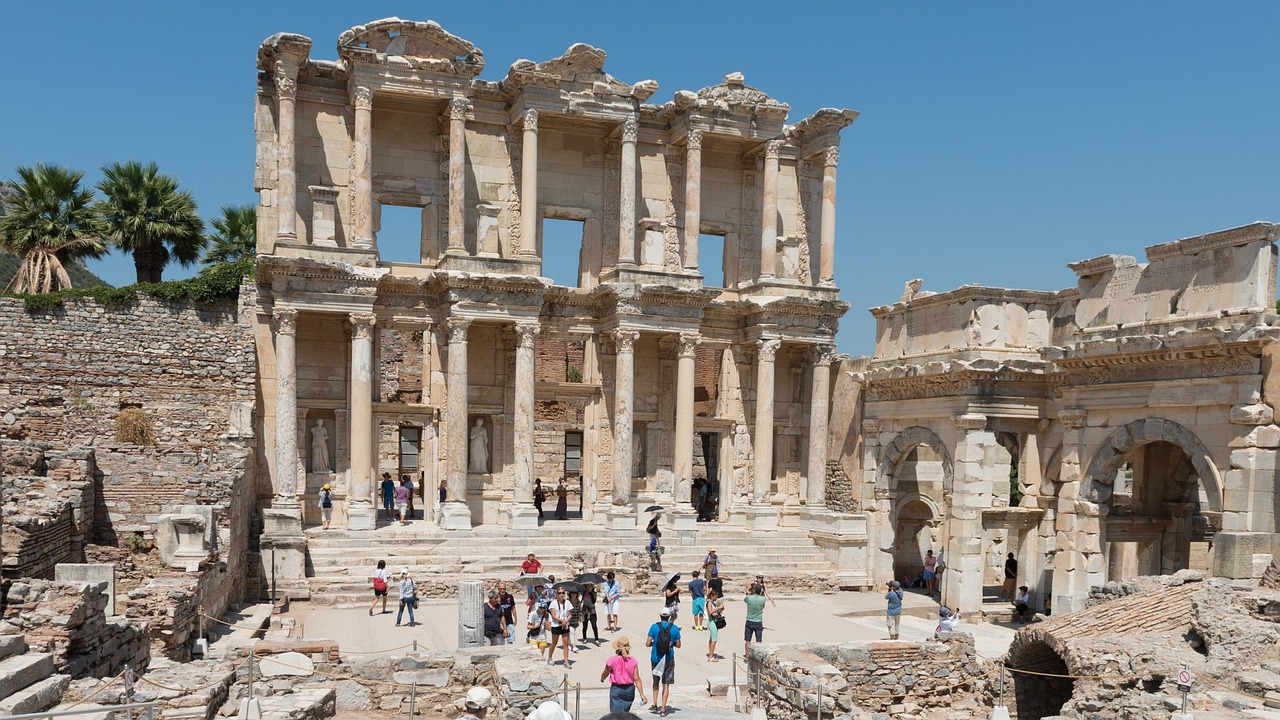
Ephesus provides perhaps the most dramatic surviving setting associated with Paul’s ministry. Acts says that Paul remained in the city for an extended period and that the message spread throughout the Roman province of Asia. The result was not merely religious discussion. It eventually affected people whose livelihoods were tied to the worship of Artemis.
According to Acts 19, Demetrius the silversmith warned other craftsmen that Paul’s preaching threatened both their trade and the prestige of Artemis. A crowd surged into the city’s great theater and shouted in praise of the goddess for roughly two hours.
That theater still dominates the archaeological site of Ephesus. Its vast seating capacity helps modern visitors grasp the scale of what Luke describes. The confrontation was not occurring in a quiet corner. Christianity had become public enough that its message was being perceived as a threat to established religious and commercial interests.
The same chapter mentions Asiarchs, elite provincial figures associated with civic and religious life in Roman Asia. Numerous inscriptions have confirmed the use of that title. Once again, Luke’s vocabulary fits the local world he is describing.
Ephesus is especially important because its Christian story did not end when Paul left. The New Testament later associates Timothy with Ephesus. Revelation addresses the church there. By the early second century, Ignatius of Antioch wrote directly to the Ephesian church while traveling toward martyrdom in Rome. He referred warmly to their Christian heritage and explicitly connected them with Paul.
Caesarea and the church before Roman power
After Paul’s arrest in Jerusalem, he was transferred to Caesarea Maritima, the Roman administrative center of Judea. Acts says he was kept in Herod’s praetorium and appeared before the governors Felix and Festus, as well as Herod Agrippa II.
Herod the Great had transformed Caesarea into a major harbor city, complete with monumental architecture and a palace complex extending toward the sea. After Judea came under direct Roman administration, Caesarea became the seat of the provincial governor. The remains of the Herodian palace complex provide the setting for Paul’s lengthy imprisonment and hearings.
These episodes are important for the developing legal history of Christianity. Again and again in Acts, Christian preaching is brought before Roman authorities. The accusations vary, but Luke repeatedly distinguishes theological opposition from crimes against Roman law. In Corinth Gallio refuses to adjudicate what he sees as an internal dispute over Jewish religion. In Caesarea Paul appeals his case through Roman legal channels and ultimately invokes his right as a Roman citizen to appeal to Caesar.
The early church was learning to live under imperial authority long before empire-wide persecution became a defining part of Christian memory.
The road to Rome
Acts closes with Paul approaching Rome, the capital of the empire, after a long and dangerous journey. Christians from Rome came out to meet him at the Forum of Appius and Three Taverns along the Appian Way. That detail is easy to read past, but it captures the extraordinary geographic transformation that has occurred across the book.
The story began in Jerusalem with a relatively small group of disciples. By the final chapter, Christians were already living in Rome and traveling out along one of Italy’s great roads to welcome Paul.
Luke does not give us the rest of Paul’s life. Acts ends with him under house arrest, preaching the kingdom of God and teaching about Jesus Christ. Later Christian writers preserve traditions concerning his martyrdom, and the end of Paul’s ministry becomes one of the bridges between the apostolic age and the generations that followed.
From Paul to Clement, Ignatius, and Polycarp
This is where archaeology and early Christian literature meet. The cities we encounter in Acts did not simply vanish from the Christian story when Paul’s journeys ended.
Near the end of the first century, Clement of Rome wrote to the church at Corinth. In doing so, he referred to the sufferings of Peter and Paul as examples from the recent past. Whatever questions remain about precise dates and circumstances, Clement’s letter shows that Paul was already part of the remembered history of the church within a generation of the apostles.
In the early second century, Ignatius of Antioch wrote to the Christians at Ephesus while being taken toward Rome. His letter is addressed to a church that had existed for decades by that point. He explicitly speaks of Paul and treats the Ephesian congregation not as a newly planted mission but as an established Christian community.
Polycarp of Smyrna similarly wrote to the church at Philippi and reminded his readers that Paul had taught among them and later written to them. That statement is especially powerful when set beside Acts and Philippians. The congregation Paul helped establish in Macedonia was still there in the next generation, reading his letters and remembering his ministry.
This continuity is one of the most important features of early church history. Acts is not a self-contained heroic age sealed off from what came next. The churches founded and strengthened during the apostolic period became the churches addressed by the earliest post-apostolic writers.
Christianity left footprints
Archaeology does not replace Scripture, and it cannot excavate faith. What it can do is recover pieces of the world in which the earliest Christians lived. Roman roads show us how missionaries moved. Inscriptions preserve the titles of officials Luke names. Civic monuments give scale to events that can otherwise feel distant. The Gallio inscription helps anchor Pauline chronology. The theater at Ephesus allows us to imagine the noise and pressure of a crowd whose religious loyalties and economic interests had collided with the Christian message.
Just as importantly, the writings of Clement, Ignatius, and Polycarp carry the story forward. Corinth, Ephesus, Philippi, and Rome were not merely stops on Paul’s itinerary. They became enduring centers of Christian life whose congregations passed from the apostolic generation into the early church.
The first Christians traveled real roads, entered real cities, stood before real officials, challenged established religious systems, formed communities, wrote letters, suffered opposition, and handed their faith to those who came after them. Nearly two thousand years later, the stones, inscriptions, streets, and surviving texts still allow us to walk through portions of that world.
That is what makes biblical archaeology so valuable to church history. It does not turn faith into a museum exhibit. It reminds us that Christianity entered history, moved through geography, and left footprints.
Sources and further reading
- Associates for Biblical Research, Digging for Truth Episode 139 — “The Apostle Paul: The Top Ten Archaeological Discoveries”
- Bryan Windle, discussion of Sergius Paulus, Gallio, and Pauline chronology
- 1 Clement 5 — early Christian remembrance of Peter and Paul
- Ignatius, Letter to the Ephesians 12 — Paul and the Ephesian church
- Polycarp, Letter to the Philippians 3 — remembrance of Paul’s ministry and letter
